
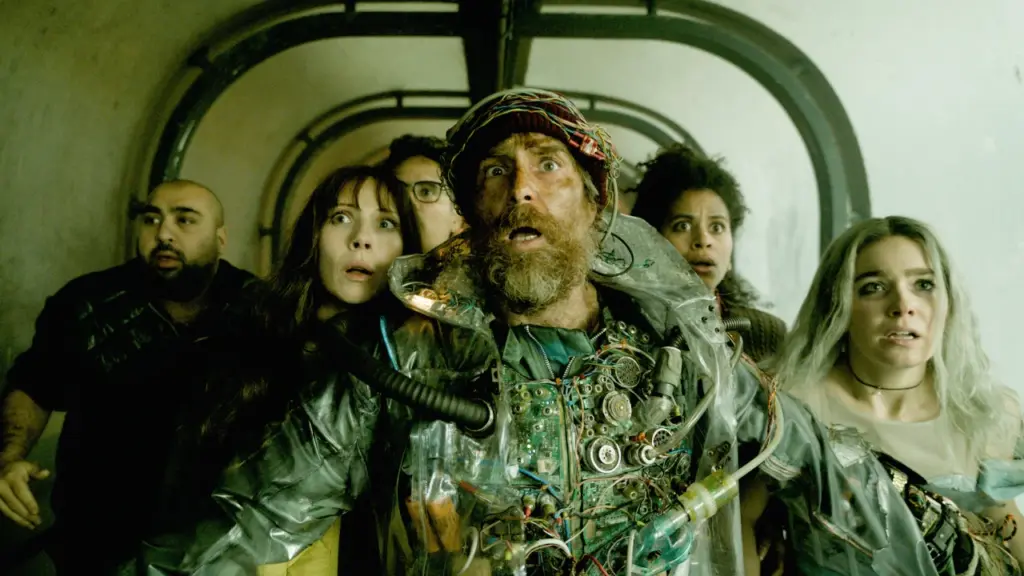
I distinctly remember that moment in college way back in 1990 when my friend rented Repo Man at the local VHS rental store and said “you’ve got to see this.” Unencumbered with any foreknowledge, I raw-dogged Repo Man and got a scorching case of the “WTFs.” Just try to describe Repo Man to anybody. It is marginally easier to define than Eraserhead, but more difficult than the Matrix, 12 Monkeys, or Black Mirror.
I mention these shows because they all play an instrumental part in making Gore Verbinski’s new gonzo romp Good Luck, Have Fun, Don’t Die such an enjoyable movie. Good Luck is an extended homage to these weird cult movies and a few others.
It has all the weirdness and irreverence of Repo Man, right down to a pair of hitmen, in a Chevy Malibu, with masks, being paid $50,000 to catch a mysterious traveler. Good Luck‘s Malibu is from the early 1980s, not the 1960s.
It also borrows heavily from 12 Monkeys in its look and story line. However, rather than a virus wiping out humanity, for Good Luck it is AI turning us all into mindless zombies glued to our TikToks. This is not a difficult future to imagine.
Moreover, there are a lot of Black Mirror storylines replicated as well. One character’s backstory concerns a mother — a frumpy Juno Temple — who has lost her son to a school shooting. A shadowy cabal of quasi-government-techbros can gleefully clone her dead son, as long as mom does not mind the occasional advertisement for fruit beverages and awkward greetings to anybody who looks vaguely like a veteran. Black Mirror did this exact story at least two or three times.
However, this backstory and the main quest comprise a plot that is rich in weirdness, stuffed with satire, and dripping with commentary on our technology-brainwashed “culture.” I am not going to retell the plot, as it seems most reviews of this movie feel compelled to do. Suffice to say there is a main quest to stop AI and a bunch of flashbacks to tell the backstories of key characters. Other reviews called this plot complex; it is not.
The pacing is a little odd at times. Verbinski never misses a moment to ratchet up the action into a frenetic, noisy spectacle that quickly goes off the rails. The odd pacing makes the humor equally odd. Some of the jokes do not quite land correctly. The frenetic energy and irreverent sarcasm sometimes fail to jell. Nevertheless, these are minor distractions. The whole of the movie remains enjoyable.
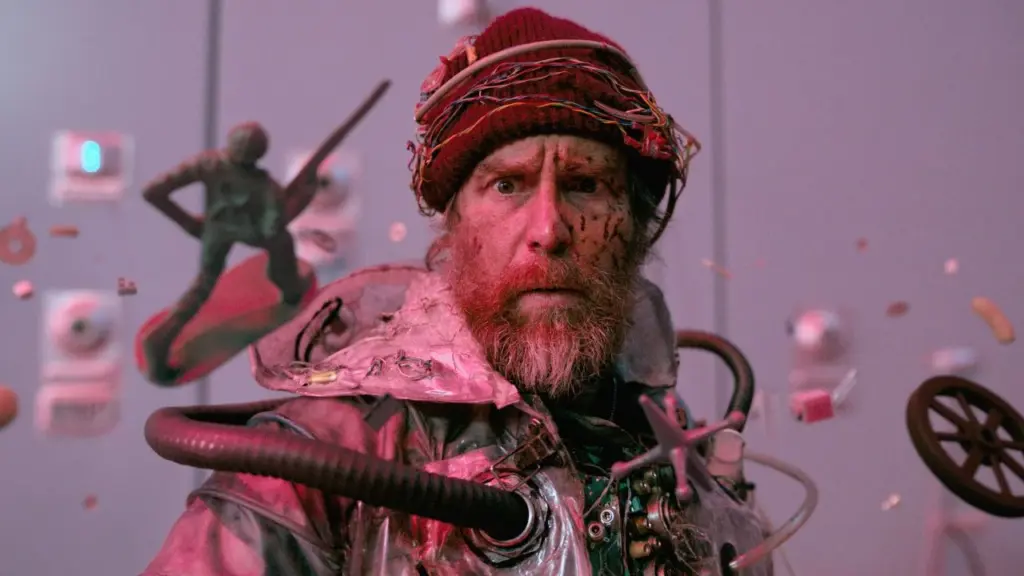
What also does not hurt the movie is the cast. Verbinski assembled the exact right people for this movie, starting with Sam Rockwell. You can credit Rockwell’s zany, goofball humor carrying most of the movie’s weight. He was the only person who could pull off the main character, a nameless time traveler. Rockwell is arguably one of the best actors out there, as he never turns in a bad performance. However, Rockwell is not alone. He has a bunch of other solid actors, including Michael Peña, Zazie Beetz, and the aforementioned Juno Temple to support him.
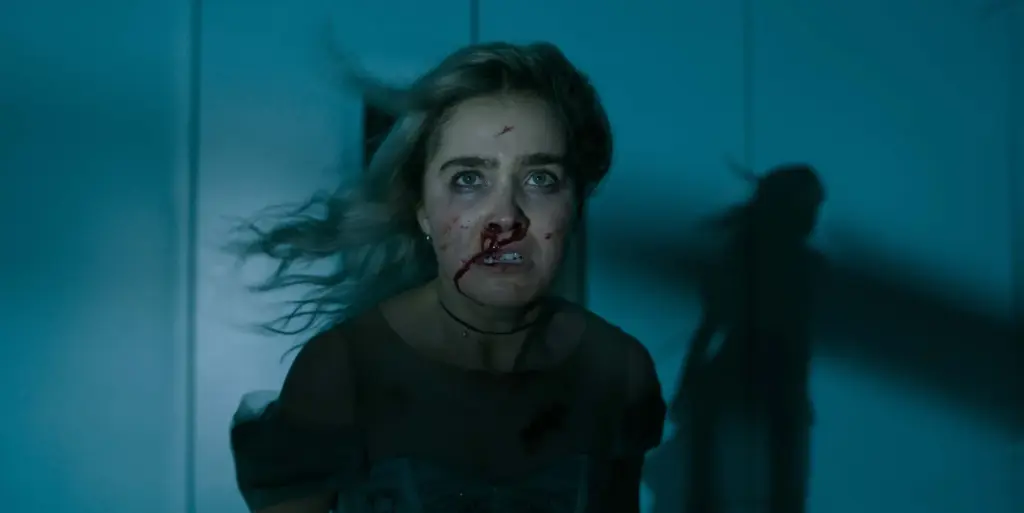
And then there is Haley Lu Richardson, who plays Ingrid, a depressed punk in a rumpled princess dress. You might remember her from such shows as The White Lotus (season 2), where she played a hapless personal assistant swept up in Italian intrigue. In Good Luck, she plays a hapless princess impersonator who is Wi-Fi-intolerant and swept up in AI-fueled intrigue.
Richardson is an unconventional actor. She has a quirky delivery, diminutive stature, and walks with a cowboy swagger like she’s got two pistols on her hip. Behind her big, sweet, puppydog eyes are a terrifying mix of adorable cuddles and white-hot rage. She was fantastic in The White Lotus, and Good Luck is no different. Maybe I have a fondness for her since she grew up in Phoenix, Ariz., where I did. Whatever it is, I feel like she is always restraining herself. If she unleashes her full performance, we may glimpse something tremendous (or awful). Whatever it is, I am fascinated.
The brains behind all this chaos is Verbinski, who was a reliable director in the early aughts, with successive Pirates of the Caribbean movies (alongside the inspired The Ring and underrated The Weather Man), until he directed the giant steaming pile of poop The Lone Ranger in 2013. 2017’s middling Cure for Wellness was an attempt to regain his mojo — which failed. Probably because he cast reliably weak actors Dane DeHaan and Mia Goth in the main roles. Good Luck is a return to form for Verbinski, aided with Matthew Robinson’s solid script.
Good Luck reminds me of a lot of other shows. Upon reflection, though, what I really like about it is its zany energy, akin to Verbinski’s break-out movie, 1997’s Mouse Hunt. Good Luck feels more like the first season of Fallout than Repo Man. All of these shows share a similar disdain for the ordinary, never passing up a chance to poke fun at modern life.
Good Luck is not for everybody. Its audience will forever remain limited to the same people who loved Repo Man, Black Mirror, and so forth. That includes me. If you like your time-travel stories on the weird side, this movie will deliver the goods.
Thinking back to Repo Man, I am drawn to the scene where a beleaguered Harry Dean Stanton tells a fresh-faced Emilo Estevez the “Code of the Repo Man.” It is a weird sequence, but it captures the essence of what a cult movie is all about: meme-worthy moments that feel dramatic and profound but are merely goofy and satirical. Good Luck is 2 hours of that, and it is a lot of fun.