
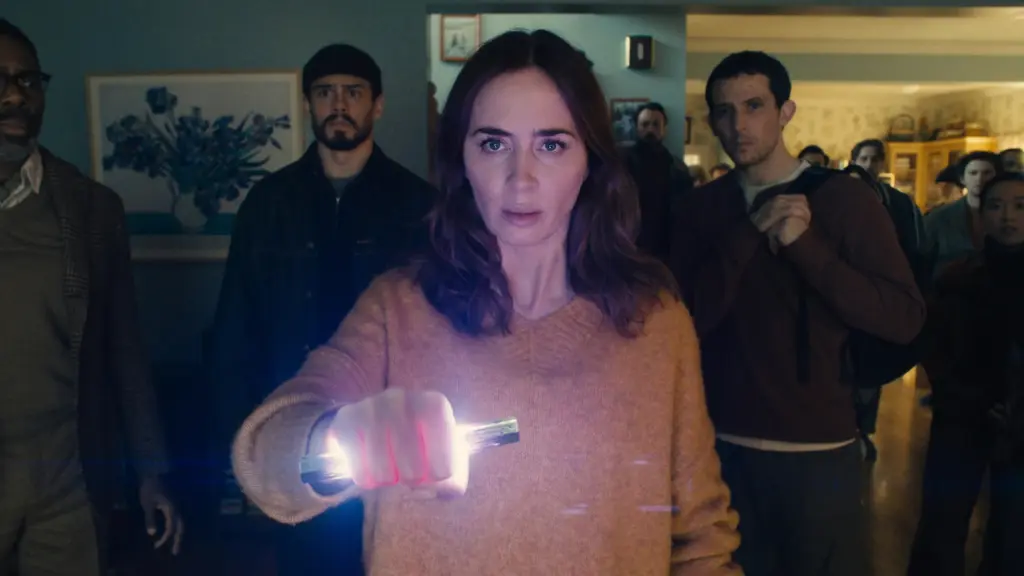
I purposely avoided previews of Disclosure Day, wanting to go in without any expectations. But I did briefly see a preview where a confused Emily Blunt makes clicking sounds in a TV studio. It was enough to suggest that Steven Spielberg would be exploring his alien-contact theme again — following up on Close Encounters, E.T., and War of the Worlds. I thought perhaps Blunt might peel her face off turn out to be a mutant They Live alien with amnesia, or — click, crackle, cluck — have an alien addiction to Pop Rocks. I was wrong, thankfully: Blunt’s character is human, and her power cheekbones are used to full effect for the movie’s 2 hour, 25 minute runtime. But I was right that Spielberg would use the premise to embrace themes and cinematic techniques he’s honed throughout his astonishing feature-film career.
The first such technique is to lead with action, so after the title curiously highlights the “SOS” in “Disclosure Day,” the film opens with a sweaty performer stomping his opponent during a pro-wrestling match — with a POV of the foot stomping us. Within the crowd watching and applauding this noisy violence sits a quiet, nervous man. He’s Daniel Kellner (Josh O’Connor), the first of two main protagonists, and in this darkly lit sequence we discover that a top-secret government agency is holding his girlfriend hostage unless he gives back data he has stolen via his cybersecurity job (ala Edward Snowden). The scene rapidly leads to action, a car chase, and a concerned voice on a burner phone telling Daniel where to find a secluded safehouse.
Then we cut to the other main protagonist, but this time it’s a daytime, colorful scene as a TV weather forecaster named Margaret Fairchild (Emily Blunt) shimmys playfully, and somewhat self-degradingly, while warning her Kansas City audience of an upcoming hail storm. The next morning, in her downtown loft apartment, she’s discussing her career ambitions with her boyfriend, a pampered-hipster musician who offers half-hearted support. From an outside window, a red cardinal lands and stares at her. She’s mystified; the bird seems to have triggered something in her.
Without realizing it, Margaret starts speaking in other languages. She blurts out phrases in Russian, perplexing her boyfriend and herself (she heard her own words as English). Arriving late to work, she’s able to speak Korean with a geopolitical expert about to be interviewed on-air (the movie builds up background hints that the world is on the verge of World War III). She also inexplicably knows everyone’s intimate secrets, getting out of a traffic ticket by advising the stunned officer to apologize to his wife — and bringing home a slice of her red-velvet cake wouldn’t hurt, either.
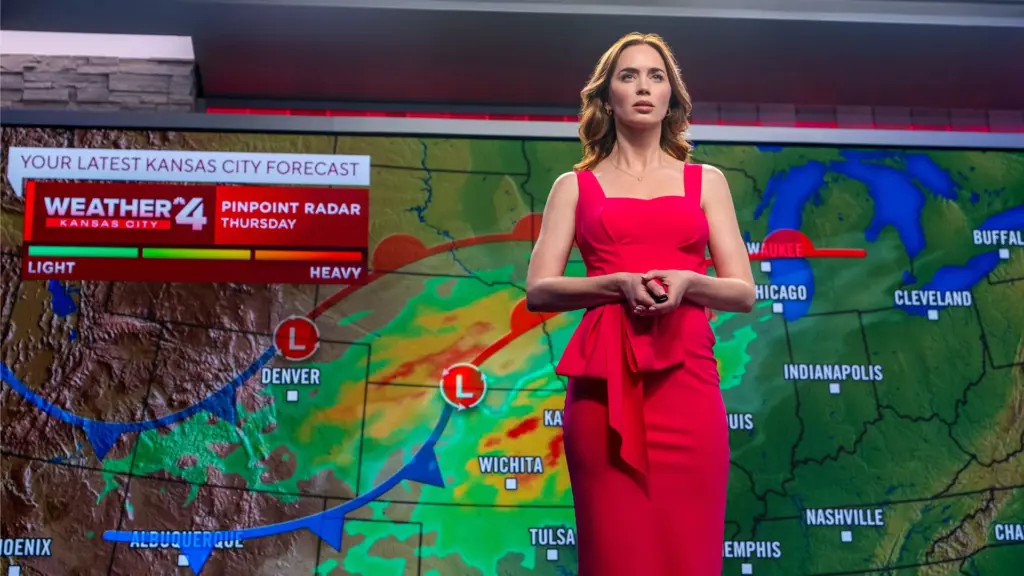
In short, Emily Blunt’s character becomes the equivalent of the Minority Report precog Agatha. If you recall that 2002 Steven Spielberg movie, when Agatha and Tom Cruise’s character were on the run, she stopped suddenly in the mall to tell a woman, “Don’t go home. He knows,” which the concerned woman immediately understood. There was no follow-up, but in those brief moments the audience could imagine a whole scenario in which a woman might be safer heading to an undisclosed location.
Disclosure Day explores that power further — what if you not only knew every language, but could look a person in the eye and know what they cared about the most? (The scenario reminded me of a 2015 interview with Barack Obama about what superpower he’d like to have, and he said to speak any language.) Close Encounters envisioned a symbolic Tower of Babel that could only be surmounted by the language of music; Disclosure Day opts for both language expertise and attentive psychological understanding. The problem is that Margaret is as confused by her newfound ability as anyone else, and when she’s rushed on-camera for her next weather report, she unleashes a series of glottal, clicking sounds until she collapses.
I must pause here to mention how wonderful Emily Blunt is in this role, frequently performing opposing emotions at once — excited while perplexed, amazed while exhausted, often slinging rapid-fire dialogue as though repeating a radio broadcast for people who can only hear speed-talking. Josh O’Connor is very good as her counterpart, playing a cryptographer with a similarly alien-bestowed, complementary, gift of understanding — math to her empath. (O’Connor’s religious conundrum with his girlfriend is reminiscent of his role in the third Knives Out movie, and a vaguely kinky scene where he ties her to their motel bed is reminiscent of his role in Challengers.)
It takes a while for Disclosure Day to cut to the chase — or several chases — due to multiple characters in play. Daniel and his strikingly blue-eyed girlfriend Jane (Eve Hewson) keep barely escaping government agents driving in a fleet of black cars, and when Daniel tells her he’s planning to release a trove of 79 years worth of documented alien sightings and experiments (basically every Roswell rumor, Area 51 conspiracy, and X-Files episode put together — there’s too much to easily dismiss), she turns out to be a lapsed nun who worries the information will destroy every religion’s faith in God. Spielberg, showing his preference for showing over telling, quickly turns this spiritual debate into a symbolic battle between a stigmata-like wound from a clutched crucifix and a powerful alien multi-tool being used to manipulate characters from afar.
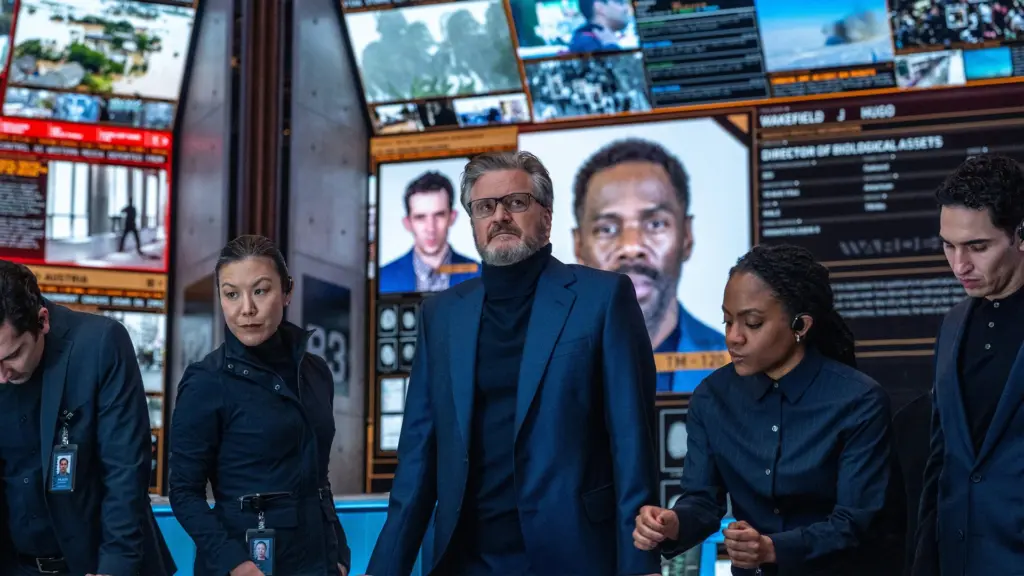
That tool is wielded by Noah Scanlon (Colin Firth), the main antagonist, whose job is to maintain secrecy and control, even if it means using alien technology to kill people. The mysterious alien device, which resembles something a happy family would smile at around the table on Led Zeppelin’s Presence album cover, gives Firth a Minority Report-like ability to see through other people’s eyes, but the empathy function of the devices hurts his brain, because he’s got the “sin of empathy” mindset of the sort that really set people off after bishop Mariann Edgar Budde gave her inaugural sermon in January 2025.
The four-way action has Blunt and her boyfriend (Wyatt Russell as the same kind of wannabe-cool cad he played in Everybody Wants Some!!) trying to reach Daniel (Josh O’Connor) and his religious girlfriend (Hewson), who ironically is possessed by baddie Firth, while the good guys (led by Hugo, as played smoothly by Colman Domingo) attempt to spread truth and information in time to raise the horizons of eight billion people before the world implodes. There’s a bit of a Day the Earth Stood Still motivation, with a North by Northwest sense of urgency, and the added element that Margaret and Daniel appear to be like the Keymaster and the Gatekeeper (or, more annoyingly, the superheroes in Hancock) — they’re psychically drawn to each other, as if the screenplay itself used magnets in place of their names. Also, as creepy as Firth’s leading villain can be, it rings true that sometimes the ones following orders (such as the rudderless minion played by Henry Lloyd-Hughes) are worse.
Where suspension of disbelief is concerned, Spielberg (and screenwriter David Koepp) are asking a lot of the audience, and I, for one, was happy to go along with most of it. Spielberg often tries for multiple goals simultaneously, and here he both indulges thematic meaning and the thrill of a few solid action set-pieces. The biggest one has him revisiting an excellent scene in his first feature film, Duel (1971), involving two vehicles and a passing train. Spielberg then expands the action to something reminiscent of Raiders of the Lost Ark, culminating in another Spielberg specialty: Catharsis. I’ve never seen a panic attack depicted so viscerally on film, nor seen the tension of piano strings used in such a boldly symbolic way. The entire sequence is fantastic, and makes up for some of the film’s later slog.
When Disclosure Day strives for its most trenchant moments, it slows down like when you’re on an amusement-park ride that has paused for temporary maintenance. A pensive scene involving a replica of the house where Margaret Fairchild grew up feels tuned to another movie’s frequency, though I know Spielberg was trying something interesting involving the importance of home (Margaret clutches at a bowl of crayons in the same way Jane clutched her crucifix earlier). Spielberg’s own empathy-focused technique, showing not only action but how people respond to action, can be highly effective in small doses (as in the sudden zoom on Roy Scheider’s face in Jaws), but on a larger scale even a slight miscalibration can make it feel inauthentic.
Disclosure Day’s biggest frustration is that by the time the full “disclosure” arrives, it’s a toss-up whether to applaud or collapse — impressively detailed and visually stunning though much of it is. To be fair, the word means more than one thing: there are numerous mini-disclosures and truths throughout the film, from Margaret’s insights of sidecharacters, to discussions of childhood traumas (each character was devastated at the age of 10, echoing Spielberg’s The Fabelmans divorce drama), and revealed cross-purposes in the key characters’ romantic relationships. (Similarly, in War of the Worlds, the “worlds” at war involved parental perspectives, reactions to crisis, and opposing mindsets — not just immunocompromised frog monsters.)
At times Spielberg goes all-out sentimental, and the use of CGI animals coming to look at characters — a red cardinal, a fox, an uncanny valley’s worth of deer — is one of his fairy-tale indulgences. There’s some Disney-style silliness, too: A late scene involving invisible vehicles reminded me of a childhood favorite, 1972’s Now You See Him, Now You Don’t, in much the same way E.T.‘s soaring bike-riders reminded me of Escape to Witch Mountain, with its flying Winnebago.
Several story’s elements feel outdated, such as burner phones (and a comic scene of a character stomping one, calling back to the opening wrestling move). Teams of agents descend on a motel and don’t cover the back door? The convenient cliffhanger solution is to make the antagonists incompetent. Also, these days, is a local network’s TV news feed really the strongest option for revealing information? Perhaps Spielberg is taking a stand for old-school broadcast journalism, while warning that its potency is under threat — not just by plug-pulling government censors but by new levels of fakery. (When a character mentions AI, it’s almost as if Debbie Downer herself leans into the movie, womp womp and all.)
Still, I’ll take flawed Spielberg over no Spielberg. Disclosure Day feels focused and inspired for much of its runtime, and when it slips it’s bolstered by a committed cast (not to mention a suitable score by John Williams and the gorgeous glaring visuals of Janusz Kamiński). Spielberg’s convictions about the possibility of alien life are so strong here that it makes me wonder if the 79-year-old filmmaking wizard knows something we don’t. Spielberg’s impulses toward storytelling have sometimes won over truthtelling (especially with Catch Me If You Can), but Disclosure Day‘s end statement hits the mark — urging us all to “listen.” Only when people are ready to listen can truthtelling serve a purpose.