
Christopher Nolan, often loved for grandiose cleverness and loathed for talky earnestness, has scaled his own Mount Olympus with The Odyssey. Many movies explore the classic themes of a Hero’s Journey, but Nolan has cashed in on his Oppenheimer (2023) clout by conquering the ultimate Hero’s Journey — the first cohesive epic in human history. It’s Nolan’s best gimmick so far: Instead of rebottling the Power of Myth waters, why not go directly to the well?
The Odyssey is to Christopher Nolan what the first three Lord of the Rings films were to Peter Jackson: The challenge of its vast story reins in the director’s excesses, keeping his style in service to substance. Nolan’s overwrought love of Pensive, Serious Moments actually works here, and Nolan’s tendency to Nolansplain everything is, this time, welcome. I didn’t bring Cliffs Notes and appreciated the assist! Nolan also seems to have listened to complaints about his sound-mixing: Unlike 2020’s Tenet, I could understand all of the dialogue, no matter how hushed and gravelly.
This is a three-hour film where I didn’t feel like a single scene was wasted, though you’ll be fending off your own Charybdis whirlpool of urine if your theater doesn’t offer an intermission. Hint: The scenes of Charlize Theron’s Calypso, holding Matt Damon’s Odysseus a sort of amnesiac hostage, are slow enough for a bathroom sprint. I’d also recommend earplugs to offset Ludwig Göransson’s drum-heavy music during action scenes (he’s good, but doesn’t reach melodic heights like previous Nolan collaborator Hans Zimmer).
As The Odyssey begins, it feels like it’s momentarily giving the nod to Sinners (2025) when Travis Scott, American rapper, bangs a stick on the floor to get an audience’s attention. With just a few loud knocks, Nolan has linked the oral traditions of 8th-century BCE to who we are today — bridging close to 3,000 years with three thumps. From there, the movie is off and running — and running its mouth, as multiple characters describe the 20-year voyage of Odysseus from home, to distant war, and home again criss-crossing Mediterranean seas.
When Nolan used a mosaic-like storytelling structure for Oppenheimer, it often seemed too choppy, but in The Odyssey it fits well and eases into a chronological structure. I knew going in that Nolan wouldn’t be making a cheesy ocean epic along the lines of Ray Harryhausen’s Jason and the Argonauts or The Seventh Voyage of Sinbad — childhood favorites full of stop-motion animation and oiled-up, shirtless sailors who always remind me of that scene in Airplane! when Peter Graves asks a kid, “Do you like movies about gladiators?”
But I also worried that Nolan’s tendency toward middle-range imagery would detract from the visual splendor of Hollywood’s colorful, wide-screen classics, which tended to soar above for God’s-eye views. Nolan meets us part-way on that point: It’s a great-looking film but the camera is usually grounded at human-level. We rarely see full views of cities, and when we eventually do see the Trojan Horse or the Cyclops, we’re looking up.
I’d forgotten much of the intricacy of The Odyssey‘s plotline since reading it (or half-assing my way through a synopsis) in high school. The movie, with Nolan’s dialogue in plain English instead of the poem’s dactylic hexameter, makes it easy to understand. I’ve read a lot of critics complaining the story is not what it should be: That Odysseus isn’t multidimensional enough, that its sexiest aspects aren’t given their due (why isn’t Odysseus more of a party animal?), that everybody isn’t eating pita bread, dolmas, and juicy tomatoes. They’re looking that Trojan Horse in its Gaping Trojan Mouth: To do the story full justice, it would need to be a 15-hour miniseries, and maybe somebody can produce that later. For me, it’s enough that Nolan’s version brings the ancient tale up to a current standard.
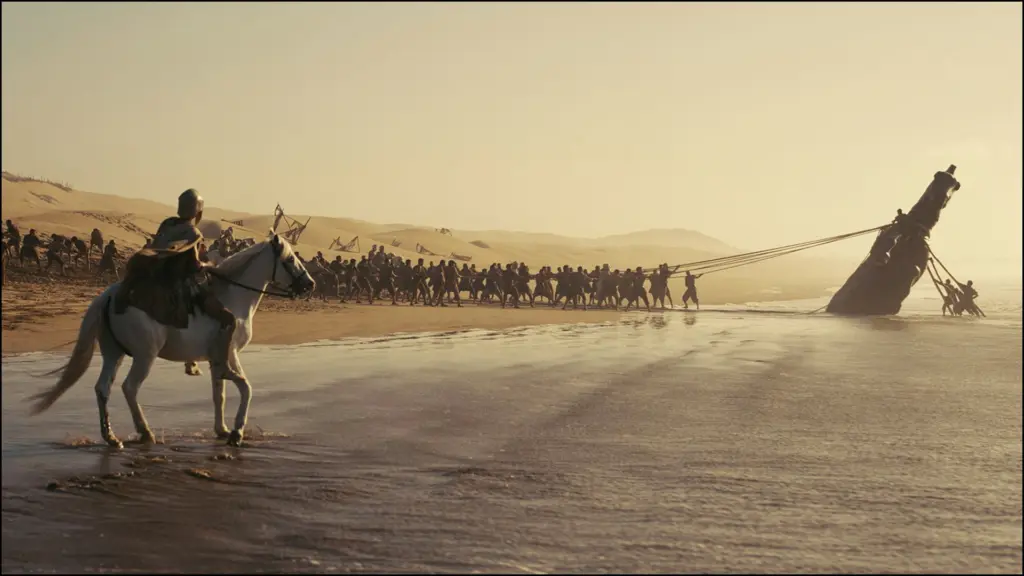
Throughout The Odyssey, bits of Homer’s tale (whoever Homer really was) are welded to the Trojan War story of The Iliad, and even a few aspects of Virgil’s The Aeneid. You need not know much about Helen of Sparta’s abduction by Paris, or the difference between Helen and her twin sister Clytemnestra (which I initially assumed was something that needed to be treated with penicillin). You also needn’t know the geography of the Aegean or Ionian seas, or whether the characters are sailing near Turkey, Greece, Sicily, or a giant rubber ducky in Zeus’s bathtub. You will quickly be reminded that the 10-year siege of Troy was ended after Odysseus hatched a plan to feign retreat and leave a giant wooden statue on the beach as a parting gift.
The Trojan Horse, containing a small group of soldiers waiting to sneak out for a night attack, is both a plot point and central to the theme. With this trust-abusing trick, Odysseus violates Zeus’s Law, which dictates that hosts should be generous to their guests, and guests should be gracious to their hosts: Pretty much common decency. Matt Damon’s Odysseus spends the entire film grappling with this breach: Odysseus is a singular character not just because of his virtues but because sometimes his shrewd instincts turn him into a shitheel. The story isn’t just about his fate, but the fate of all men who attempt to reconcile civilization with its atrocities.
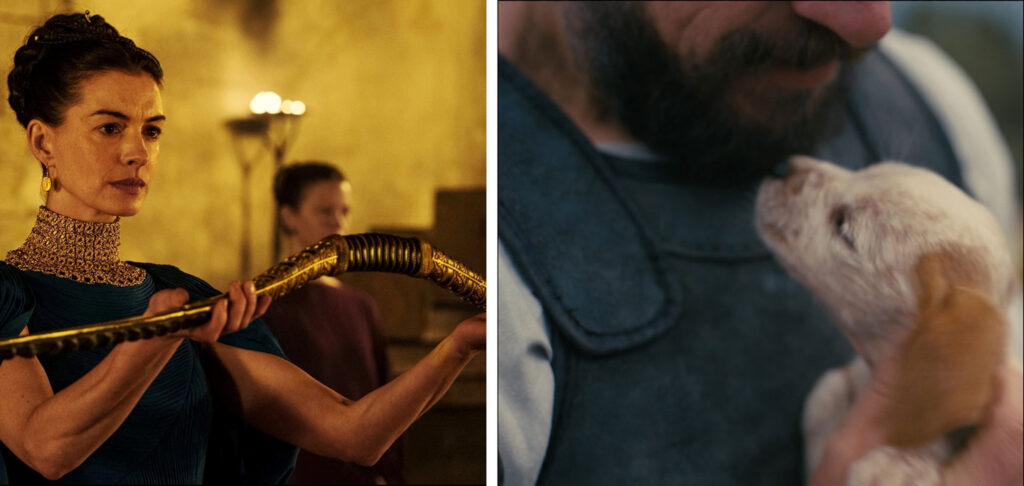
Back in Ithaca, the home Odysseus takes another 10 years to reach, Zeus’s Law is stretched to its bowstring-taut limits. The island’s queen Penelope (Anne Hathaway) tries to be a kindly host to a rabble of suitors who spend each evening in her dining hall, pretending to admire her while secretly vying to use marriage as a means to sieze power. Penelope has no word of Odysseus’s fate — he could have been dead for years — but tells citizens she’ll only declare herself a widow after she finishes weaving a funeral shroud, which she secretly unravels at night. The leading suitor, played with vampiric, bowl-haircutted nastiness by Robert Pattinson, figures out Athena’s ruse with the help of a disloyal housemaid, played by Mia Goth — whose plucked eyebrows make her look as creepy-beautiful as she does in her horror films.
Anne Hathaway feels just right for her role: She still makes a fair embodiment of love as in Nolan’s Interstellar, but her weathered look, consistent with her age, accentuates Penelope’s overstressed patience. In several scenes, the light catches a reflection one of Hathaway’s eyes — the spark of loyalty turned into an innate teardrop. Which the scheming Pattinson matches with an incisive tic: I swear, Pattinson has the best single facial twitch I’ve ever seen in a movie.
The Odyssey has a huge cast who all deserve mention, but let’s zero in on a few standouts. Tom Holland plays Telemachus, Odysseus’s son, with that sense of nobility but not-quite-readiness that serves him well as Spider-Man. John Leguizamo brings a warm-blanket-style charisma to Odysseus’s servant Eumaeus, a blind old swineherd who sizes up the dangerous palace intrigue and gives indispensable advice.
I really liked Himesh Patel as Eurylochus (I won’t even pretend to know how that’s pronounced), Odysseus’s lieutenant throughout their sea voyages. Patel often doubts Odysseus’s decisions (just a bit more than Odysseus doubts them himself), but his frustrations feel appropriate, not whiny, and the contrast between Patel’s Indian roots and Matt Damon’s all-purpose, white-boy style is not contrast at all — it meshes. I bring that up because there’s a gaggle of dingbats out there, online and in broadcast media, who have complained, often without seeing The Odyssey, that it’s too “woke.” Whatever “woke” is supposed to mean. Actually we all know what “woke” means: It means the person saying it is not only about to be racist, but trying to spinelessly mask their racism by projecting insincere intentions onto others.
The worst among them have complained about the casting of Elliot Page, who plays a character named Sinon, but who (because they haven’t bothered to check) many mistakenly claim plays Achilles (who isn’t in this story at all — perhaps they’re thinking of 2004’s Troy?). Elliot Page, who is transgender and appeared in Nolan’s Inception as the Greek-inspired character Ariadne, does a fine job in his minor role. The fact that Nolan cast him is heartening, going against the grain of prejudice, and demonstrating the loyalty Nolan shows toward his former collaborators — which aligns with the theme of loyalty central to The Odyssey.
Similarly, people complaining about Lupita Nyong’o (double-cast as Helen and Clytemnestra) ought to be pilloried for their racism. I hate even having to mention these matters, since I realize much of the complaining is a cynical ploy for attention on the back of a highly publicized movie. This is especially pathetic given that at least one complainer is a well-known multi-billionaire. Can you imagine being so rich and not having a soul? It must hurt to realize no matter how much wealth you have, or how much you can throw your power around, nobody — not wife nor son nor hunting dog — will ever be waiting eagerly at home for you after a 20-week journey, let alone a 20-year one. Not unless you pay them to.
Christopher Nolan’s focused earnestness in his themes does mean that The Odyssey tends toward familiar emotional tones, often feeling like a culmination of Nolan’s other films. In The Dark Knight, for example, Nolan’s dual-ferry choice combined the Trolley Problem and Prisoner’s Dilemma concepts of ethical theory. I now realize that scene, putting Batman on the spot, was a variation on the Scylla and Charybdis conundrum from The Odyssey — two Bat-, er, bad options on each side.
The symmetry of The Odyssey‘s dual Zeus’s Law scenes — the Trojan Horse on one end, and Odysseus out-Trojan-Horsing the deceptive suitors by showing up in disguise as a beggar — reminded me of Nolan’s Tenet — which is the most symmetrical movie ever made, to a fault. At another level, The Trojan Horse itself, with men silently suffocating and suffering inside of a dark vessel — is similar to that scene in Dunkirk where soldiers huddle in an upturned boat hull. The ruefulness, vast loss of time, and the opium-den-like dreamers of Inception are similar to the Ogygia hiatus with nymph Calypso (Theron). Odysseus’s loss of memory aligns with Memento, of course (thankfully not so back-asswardly), and the Athena-figure totem that helps his memory recover is reminiscent of Inception‘s spinning top.
Even Interstellar‘s wormhole communication scene links to The Odyssey‘s Land of the Dead scene, with deceased figures reaching through the past to warn Odysseus about his possible future. The ill-fated Agamemnon (Bennie Safdie, unseen under an intimidating helmet), who is the biggest baddest boss of the war, reminds his general Odysseus that returning home can be just as treacherous as the journey.
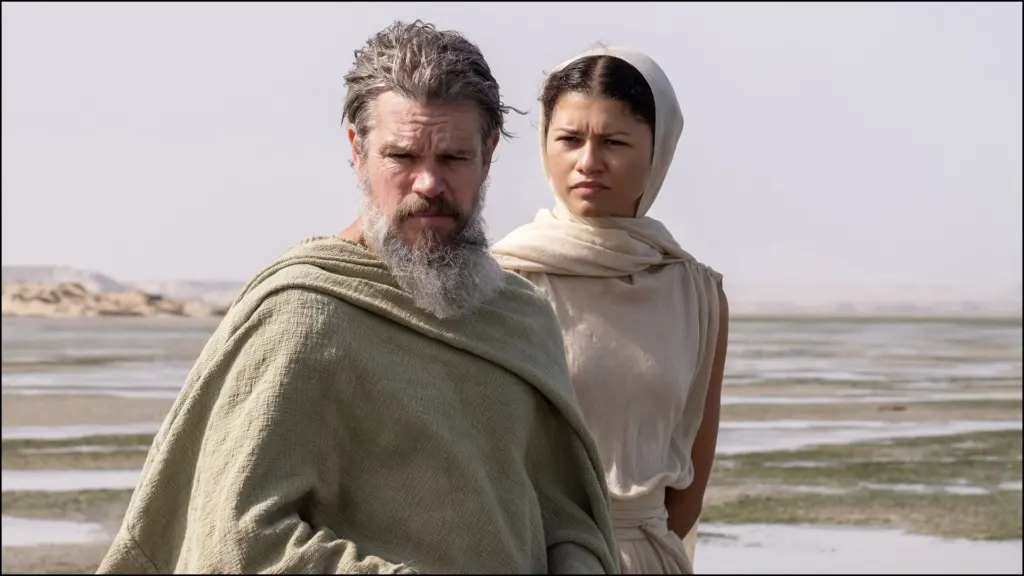
Nolan has always seemed a science-minded person with a spiritual penchant, even if the latter can feel forced. I found it interesting that, in spite of the many supernatural elements in The Odyssey, Nolan’s rendition often feels secular. In movies like Clash of the Titans, the robed Olympians squabbled among white beards and glistening tiaras while pushing clay figures of mortals over a giant Risk board. In The Odyssey, Matt Damon briefly imagines Athena (Zendaya) sitting near him, glancing disapprovingly at his doomed choices as if Spider-Man had just shot his webs prematurely. She’s more an aspect of his conscience than a supernatural force, and Zeus is a no-show — if you don’t count the occasional thunderclap.
Still, there is epic-style wonder in the middle scenes that give The Odyssey both its lit-metaphor power and its thrills. The Cyclops is the first full reminder that we’re watching a Greek myth, and its rendering is as horrible and fantastic as you could want. The placement of the Cyclops’s eye, not smack over the bridge of the nose, but twisted sideways as if the monster were birthed from a Goddess’s thunder thighs via Zeus’s formidable forceps, makes a gnarly visual. And the Cyclops is a scary, weird cave dweller who feels fully physical. (An amusing footnote: The Cyclops is portrayed by Bill Irwin, who played Mr. Noodle on Elmo’s World. “Oh boy, that tickles! You gouged my eye out!”)
One of the most memorable episodes in The Odyssey’s 24-story poem cycle involves The Sirens, sea nymphs who lure sailors to their deaths. Nolan shows a rare restraint here, leaving their visage and seductive song mysterious and distant. He lets Matt Damon’s pained description penetrate: Their song is “all the things we wished we never wished for. That delicious itch you’ve got to scratch. What you most want is what you most can’t have.”
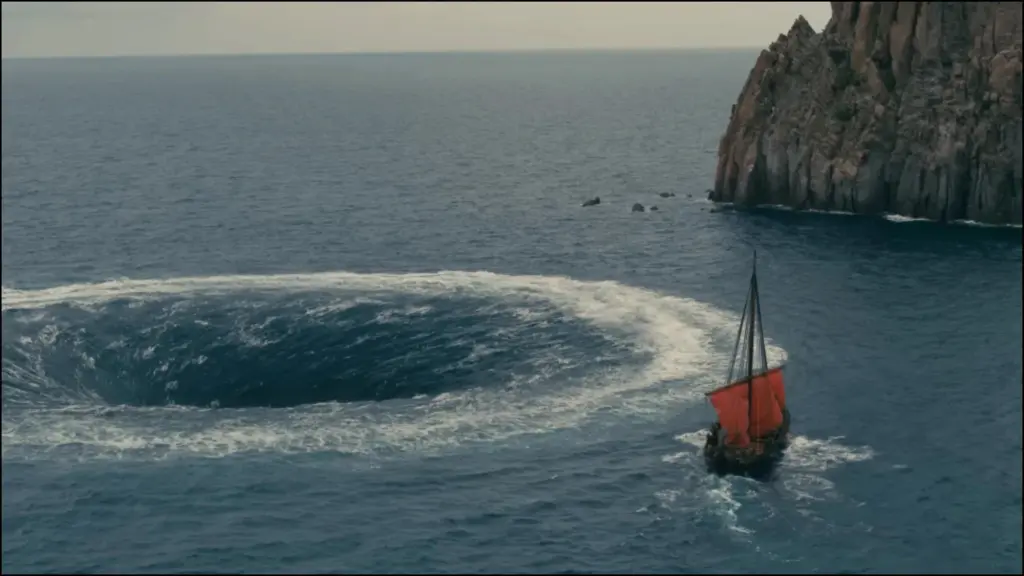
The Scylla and Charybdis scene is suitably harrowing — the whirlpool is one thing, but the monster is an actual thing, and it’s far freakier than the multi-headed dragon in usual depictions. Is it insect, alien, mutated reptile, or some combination of leathery phallic appendages and cutterfish vagina-dentata mouths? Yes, it might well be all of the above, and it’s best seen only briefly.
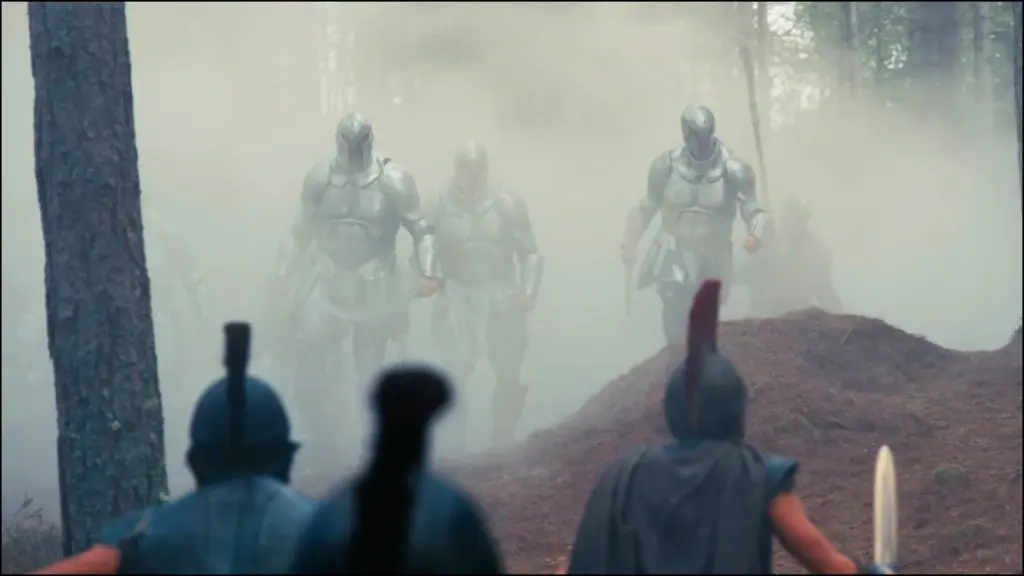
There’s another scene of these, uh, giants?, but they’re in shiny armor, they move way faster than you’d expect, and they’re mean. I’d forgotten all about these Laestrygonians, who ambush Odysseus’s men in a forest of trees that seem to shift around them like prison bars. If ever Zeus’s Law were broken by hosts being unwelcome to guests, the Laestrygonians excel at such violation. Then again, Odysseus’s men invaded Troy, and many of them raped and pillaged, so this devastating episode might just be the ultimate rendering of karma.
One of the strongest scenes in The Odyssey involves Circe. She’s just a peaceful little lady in a hillside cottage with a smoky fireplace and nice lions, leopards, and tigers on the pathway to get there, right? Odysseus’s famished men leave him behind, partly because of his tendency to pluck his bowstring to give animals fair warning. As it turns out, Circe — played by Samantha Morton — is yet another dangerous nymph, and even though she serves the men hot, sloshing soup filled with fat ribbons of meat, she’s no fan of men’s voracious appetites. Wondering why his crew haven’t returned, Odysseus finds that Circe’s porch houses groveling pigs that didn’t seem to be there earlier. I don’t like to call Oscar wins, but Samantha Morton’s performance throughout this segment blew me away. She’s the standout of the entire film.
It’s forgivable that Nolan chose to alter the Circe episode severely from the original story, in which Odysseus shacks up with the talented witch for a year, they have children, and so on. Nolan’s version of The Odyssey keeps our sympathies tight with Odysseus The Dutiful Husband, not Odysseus the Man-Whore, bringing us back to a stirring homecoming between Matt Damon and Anne Hathaway (their fates align much better than they did in Interstellar). However, the Circe scene does underscore the link between the groteseque eating habits of Odysseus’s men and those of Penelope’s boorish suitors.
When The Odyssey ends, we’re primed for a rousing return, and that’s what we get. We even get a little too much. In the final, Game of Thrones-style mess-hall battle, I didn’t mind that Matt Damon almost turned into Legolas with his rapid-fire archery skills — I was just glad that he never surfed down a stone staircase on an upturned shield, and that his human-pincushion wounds weren’t as Boromir-level conclusive. I could have done with fewer scenes of Telemachus (Holland) trying to stop one of the suitors from dropping spears down a hole in the ceiling, but composer Ludwig Göransson needed suspense-buildup to bang his drums to, dammit, so that Nolan could crank the volume to iota-alpha (that is, 11) and remind all of us to stock up on earplugs next time.
And there could well be a next time, because I’d glady see all three hours of The Odyssey again.